26f7.jpg?format=1500w)
Holiday Drinks with Milk: Winter Cocktails and Mocktails
Picture courtesy of Heidi Billotto.
If you’ve ever sat in a cozy tearoom in the U.K., drinks with milk are common. Imagine hands wrapped around a mug of strong black tea softened with a splash of milk; you already know the secret milk-washing adds to a drink. The addition of milk to your tea doesn’t just tame the tannins; it gives every sip a velvety, creamy finish that feels like a lovely little luxury. That same magic translates beautifully to cocktails and mocktails, where bright, tart, or acidic ingredients meet milk, curdling on cue and transforming into something silky, clear, and downright delightful.
But milk-washing isn’t just adding milk to a cocktail. In fact, it’s quite the opposite. It’s a playful dance of curds and whey. Goldilocks would have had a field day if she’d wandered into the Three Bears’ bar, instead of their breakfast nook. In practice, milk-washing is really just culinary alchemy, but entirely worth learning about the tiny bit of science involved. Let’s look back at how it all started.
Key Takeaways on Drinks with Milk:
Milk-washing uses milk or toasted milk powder to clarify cocktails and mocktails, turning curds and whey into silky, clear drinks with a creamy finish.
The technique dates back to classic milk punch in the 1700s and now includes modern twists like toasted milk powder, espresso martinis, and spiced tea mocktails.
Home cooks can create milk-washed drinks using simple tools, such as pour-over coffee filters, warm milk, and lactose-free powdered milk for added options.
What is the Origin of Milk-washed Punch (Milk Punch)?
Milk-washing roots run deep, straight back to the 1700s, in fact, and maybe even before. Milk punch has been said to be one of Benjamin Franklin’s favorite sips. Made in large batches, gallons at a time, the recipe starts with lemon peels steeped in brandy, nutmeg, sugar, and water. After days of steeping, the mix is poured into warm milk, where the acid of the lemon curdles the dairy. The boozy blend is then strained several times through layers of cheesecloth to remove the curds, leaving a clear, smooth, clarified liquid elixir with a soft, creamy finish.
My own first milk punch was a stunner from Charlotte, NC, mixologist Amanda Britton in 2016, the year she won the North Carolina Restaurant and Lodging Association (NCRLA) Chef Showdown Mixologist of the Year. She took a classic milk punch recipe, swapped North Carolina’s Muddy River Rum for the brandy, and served it over ice. One sip and it’s easy to understand why milk punch has survived centuries of cocktail trends.
Today, the technique continues to evolve. Mixologist Daniel Villa, also from Charlotte, NC, has taken things in a brilliant new direction for us all by toasting whole milk powder before using it to clarify and round out drinks. Toasting brings out a nutty, browned-butter taste that works beautifully in cocktails and zero-proof sips. And here’s a bonus I’ve discovered: lactose-free powdered milk behaves just as well.
When you are milk-washing cocktails and mocktails, either whole warm milk or the milk made from toasted milk powder works well.
A Little Modern Magic: Skip the Cheesecloth for Your Milk Drinks
Traditional milk-washing calls for straining everything through a cheesecloth-lined bowl, which works beautifully… but also tests your patience. Securing layers of thin cheesecloth around a bowl isn’t always easy and, honestly, it’s a messy process. For a simpler approach, grab the same pour-over coffee filters you use for your morning brew. Set one in a pour-over cone, place it over a jar or bottle, and let gravity do the work. It still takes time (we’re talking several hours) - clarity can’t be rushed. But the setup is tidier and perfect for crafting cocktails and milk-based mocktails at home.
Now that you’ve got the backstory (and a few tricks up your sleeve), let’s get into the stirring and shaking.
Creamy Holiday Drinks with Milk
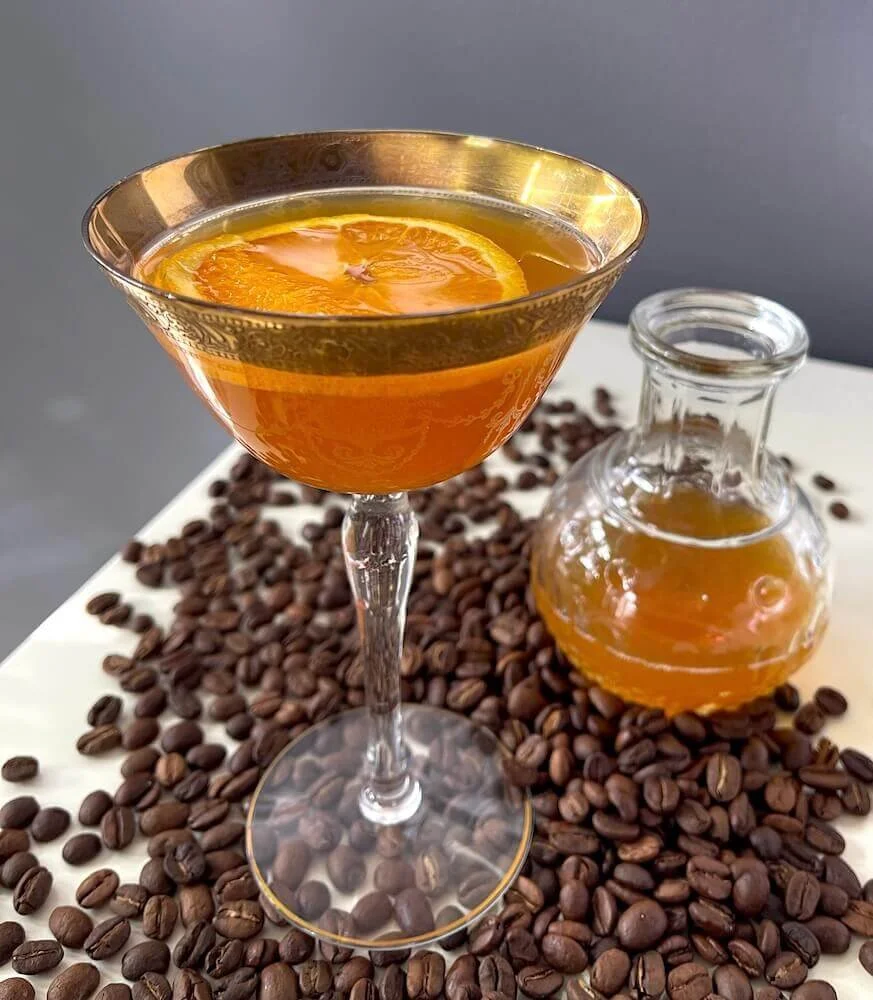
Clouds in Your Coffee Cocktail (Makes 2)
For the toasted powdered milk:
1/3 cup powdered milk (lactose-free or not)
1 cup boiling water
For the espresso martini:
½ cup strong coffee
4 Tbsp. local honey
½ cup vodka
¼ cup of your favorite coffee liqueur or coffee rum
Pinch of salt
Pinch of citric acid (available at any spice shop)
Make the toasted milk powder. Place the milk powder on a parchment paper-lined baking sheet. Place in a preheated 250-degree oven and toast for 2-3 minutes, just until it starts to turn golden brown.
Crumble the milk powder and dissolve it in 1 cup of boiling water. Mix well to combine. Set aside and allow to cool.
Meanwhile, combine the martini ingredients and shake or stir to blend.
Pour the espresso martini mixture into the milk and allow it to stand for an hour or more. The milk will form into curds.
Then pour the mixture into a coffee filter-lined cone and allow it to drip, separating the curds from the cocktail. The result is a golden-hued, creamy, clear coffee cocktail to be served on the rocks.
Spiced Tea for Two Mocktail (Makes 2)
10 oz Earl Grey tea
7 ½ oz apple cider
Lemon juice, honey, and cinnamon to taste
Pinch of salt
Pinch of citric acid
5 oz. warm whole milk
Combine the tea, apple cider, lemon juice, honey, and cinnamon and blend well. Add a pinch of salt and a pinch of citric acid.
Pour the mix into the warm whole milk. Allow to stand for an hour or so.
Use a coffee filter and a pourover cone to strain the mixture and remove the milk curds.
Serve over ice or heat to warm slightly and enjoy.
FAQs About Drinks with Milk and Milk Punch
Q: What is milk-washing in cocktails and mocktails?
A: Milk-washing is a technique where an acidic drink is mixed with warm milk so it curdles, then strained to remove the curds, leaving a clear, smooth drink with a soft, creamy texture.
Q: Where did milk-washed punch, or milk punch, originate?
A: Milk punch dates back to at least the 1700s, when spirits like brandy were steeped with citrus, sugar, and spices, then mixed with warm milk and strained to create a clarified, creamy-tasting punch.
Q: Can you make milk-washed drinks with lactose-free dairy?
A: Yes. Toasted lactose-free milk powder or lactose-free milk can be used in milk-washed cocktails and mocktails, providing the same silky texture and flavor with reduced lactose for sensitive drinkers.
The Dairy Alliance Loves Drinks with Milk
For other alcoholic drinks with milk or non-alcoholic ones, check out our other recipes.

Heidi Billotto, a Charlotte-based culinary expert, writes about food, restaurants, and food-centric travel for regional magazines, newspapers, blogs & websites. In addition, Heidi conducts private in-home or office cooking classes for corporate team building & social gatherings. Follow her culinary adventures at HeidiBillottoFood.com.
Related Posts